非主流台灣:最新公告

Welcome to the 2010 Guerilla Girls Blog! We are the Guerilla Girls! We are 13 Hao Ran Foundation volunteers (all females!) and we will soon get to deploy our wings in different countries of the world to work with various non-governmental organizations and social movements as a way to reinforce social justice and solidarity. We wish to open communication and share our experience with the rest of the world, because we strongly believe that ‘ANOTHER WORLD IS POSSIBLE!’ Read More

將文章轉換為簡體 動態調整字體大小 原字體 放大 再放大
顯示具有 English Report 標籤的文章。 顯示所有文章

2011年12月3日 星期六

Nov-Report:Forward to the beginning of the end

0 意見

Huei-Jen Lin

November is the last month for me staying in Zigen, and officially there were in fact only two weeks left. As being involving with the village work in Hebei Qinglong over than six months and being getting into those circumstances within the social issues of urban-rural divide for nearly one year, I suddenly realize that time is far from enough to accomplish something which the work I feel just being started. Thus within these two weeks (from the last third part of October) I arranged a pretty tight schedule and got a big pressure of thinking that how to give all these tasks a short ending. My director and colleagues can therefore take over these cases easily.


It never ends if you think in this way—project thinking vs. thinking of empowerment

As mentioned before, my main task in villages for six months was doing pre-investigation and project design and implementing. There were about three main projects I was working on: trying to establish and develop a women handcrafted group in Hua Guo Shan village , to develop school courses with home resource in Hua Guo Shan school, and organizing thematic courses which input living education onto the normal subjects as a base of education reform in order to influence teachers of MaZhangZi school.

Comparing to all the projects that the Qinglong director Mr. Li has to handle, these three projects are not much but been treated as the important experiments. I appreciated that Mr. Li confidently let me to try it, and meanwhile I felt that we have common goal that he turns his concern from “aid” to “support” people. Thus although each project has been designed to display its concrete outcome in terms of the evaluated result target, the project itself should be done in time but the work of doing on people must be operated for a long-term period. In the office, a colleague had doubted that such kind of project design like to organize women for being a handcrafted group or to cooperate teaching in order to influence village teachers which is inefficient. He doubted that Zigen spent much money and even set a working staff into villages for months but just for accomplishing such small projects. Isn't it inefficient and even more risky if the working staff can't stand in village so long? He thought that project design should be more practical and easily implemented, for example in regarding to the above cases, to fund the village women who have problem for running business or to give a training for village teachers so that to influence them directly. Moreover, the founding should be distributed to people who have problem for the basic need but not for the unstable work of group-capacity building and expecting them to develop the villages.

What his query is actually touching with several layers of questions in regarding to working strategies and thoughts: what specific target is Zigen's funding oriented for? need based substance or capacity? What does it mean the “basic need”? Which kind of strategic thinking does Zigen tend to operate? project thinking or the thinking of empowerment? And in this case, what is the main idea of empowerment behind ? Likewise, what role of Zigen workers can take part in and how long they can stand for it?

Zigen in transitioning: from “aid” and “charity” oriented to “development” and “advocacy” oriented

On the occasion of Zigen's annul convention in 2010, the founder had not only once talked that Zigen has necessary to be reformed: the organization which locates in China has to be stronger and should have ability to solicit for funds by itself . The main reason is that the main donor of Chinese Zigen, American Zigen foundation, may turn its concern from China to Africa or Middle America since the China's economy is getting well developing. Apart from this, the problem that Zigen face nowadays about the social and welfare development inside of China has been processed complicated and different from those days of facing problems of starvation. By being walking for twenty years, Zigen should be aware to change its role in the rural development of China and to adjust its strategy for better and independently operating the fundings. Thus, in the past, most of Zigen's cases were operated by means of projects, so the working staffs could just stay in Beijing or outside of China and remote controlled the correspondents in villages for the concrete project implementing. Also, at that time, the projects are more about supply of basic substances, like funding to children with scholarship, school desks and chairs, well, toilet and heating..etc. As the organization was established in Beijing in 2005 and the suboffices sequentially were built up too in the counties where projects were in process, the content of projects had been more developed diversely. Several independent projects have been coming out, like the project of promoting reading and the project of teacher training (RTT: Research Teacher Training) in which those are independently donated by the different big donors from HongKong and Taiwan. Moreover, some several hardware projects for villages are getting integrated into a project group called “One school one village” in order to combine the school and village building work for a better development.

By observing the transition of the contents of projects, it shows that the Zigen is turning its focus from the supply of substance to the capacity building, which is also much close to what Zigen originally aims: development based in human centered and in sustainability. Therefore, though all the works are still in processing by means of projects implementing, the projects themselves have been starting with the community work and capacity building, and the time-limit of projects are setting longer. For example, the Zigen's establishment of migrant worker community center is actually a big and long-term project. The Zigen staffs there operate it by means of community and social work.

Heard from the founder Ms. Pat Yang said, what she now is really willing to do is to work out some models of rural development or of migrant worker community in cities by addressing to the social issues and meanwhile work on the related research reports that could be the references to the government and the advocacy to the social public. Addressing to the issue against the governmental policy of “merging village schools” is the actual case which has been present in recent years.

Project thinking vs. thinking of empowerment
Regarding to the query of this colleague, we had a rather long discussion together with the director Mr. Li in the Qinglong office. Mr. Li pointed out that this is the difference between project thinking and the thinking of empower people. How this colleague had this kind of query was just because he perceived the village work in perspective of project thinking. With project thinking behind, you will design that what kind of project could efficiently solve the problems that people have and directly give the help to people's need. Then spending the less time and the less cost to realize the best accomplishment will be the priority to be taken into account. However, Mr. Li reaffirmed that what his main concern is working on people, not on the project. For him, the project is just like an instrument, which promotes the job on organizing people much easier and contributes to the job itself. It is much important to work on people that to do education for people to have common knowledges about issues of environment, women, health care and schooling which can contribute to themselves and to the development of villages. Likewise, it's also important to organize people for the community or group work in order to foster people's public sense and sense of action to their living life. This is how he thought about the empowerment. People need to be empowered and their capacities need to be discovered and developed, so the villages they live would be much possible to be build up but not to be aid.

With five-year working experiences in Zigen, Mr. Li talked about how many projects which had implemented to villages had indeed improved the villagers' living environment, but were always repeatedly aid year by year without much sustainable development. However, the real contribution was the case of cooperation business of Da-Sen Dian village. This case was that Zigen supported for five years and made people organize themselves as a team in dealing with the technical development of fruit farm and also established the collective cooperation for running the business of fruit products. After Zigen withdrew it, the villagers still can run the cooperation well so far. This relatively successful case gave him confidence to believe the importance of empowerment work.

However, comparing to working on the things, working on people is not an easy job. Indeed, it took longer time and much cost (especially for working staff's time and effort) if you work on projects with the thinking of empowerment, not with project thinking. Also, it contains high risk that you couldn't be sure whether people can be organized or go the direction where you wish to. Those efforts and works couldn't be easily evaluated by the standard of project-procedure and result ed targets as well as the most international NGOs or governments use. That's also the reason why some of Mr. Li's projects are easily criticized by the other Zigen partners when the outcome of projects couldn't be clearly displayed. It needs another standard of working procedure and staged results for evaluation which will be more proper to the working way of grass-root organization.

To organize people for what? What's the strategical idea behind the “empowerment”?
All those groups or associations organized by villagers within villages of Qinglong county were promoted and supported by Mr. Li, the director of Zigen Qinglong office. Many of those groups were established by Zigen's addressing to the issue-targeted group, like the women school (group), association of elders, parents school (group), and peasant groups (technical association or cooperation of agricultural production and marketing). However, Mr. Li sometimes pours out his questions about what for? to organize people, or organizing people and then? It's because that many of these groups didn't really work out or well, except for the one cooperation in DaSenDian village.

Many of them were finally established as a result that the leaders inside of villages were discovered and with passion to stand out under the Zigen's supporting. For example, in the association of elders, they think that they lack of cultural life,so they are willing to organze some cultural events. As for the women school, they would like to run cooperation for developing business together, or to organize some entertaining activities for the festivals. However, the groups are usually scattered by each person's living reality of hardship or original living habits. Also most of leaders of the groups don't really know how to run the group and how to apply projects to Zigen's funding. It seems like those groups lack a stronger purpose of group itself that directly reaches to their urgent need from the living reality. For the most villagers at the present situation, how to survive with enough wealth for going on a better life seems to be the priority to be concerned. For the leaders who are enthusiastic on the public affairs, the capacity building of running group is the premise that they should be provided. However, without Zigen working staff of settling in villages for the long-term working with the groups, it seems not so easy to make out. Like the cooperation of DaSenDian village, it took about three years for Zigen workers cultivated there and then could be worked out.

Empowerment, is not the idealistic phrase anymore when encountering with the local reality. Deep into the power structure of villages you will find its complication and the difficulties of interference by we, the outward ideas addressing social issues or theories of capacity building. However, for a Zigen staff, if with understanding of power relations within villages, and the knowing of exerting self's role as an outsider, and with the clear mind that which direction you are going to empower people to and which context group building can reach villagers' need in reality, the work of empowerment is possible.

Every ending story is starting off another journey
The day before heading back to Beijing, I was just staying in MaZhangZi village and trying to arrange the thematic courses for teachers of 6 grade to follow up, teaching and working with students for making out a project about a self-made Ping-Pong table. Thinking back those days of staying there, it was just like to set some roles and starting a story. But to start to negotiate with teachers about my idea of making Ping-Pong table and to organize them and courses were the most difficult parts. Till now, once I remembered of these scenes, can't stop feel funny. It was always like that I was talking about my idea that how to combine the courses so that teachers in their professional can teach students what knowledges students need for making a Ping-Pong table. After listening my idea, teachers started to talk about something else. They were always discussing that they should use what kind of materials for making a Ping-Pong table which will be cheaper, and maybe to find a bricklayer which will save more trouble. Teachers were enthusiastic of making a Ping-Pong table but seemed that they were not interested in their course application. In their discussion, there was nothing being talked which was related to students. During the long process, I was trying to make all teachers understand what's my intention and what's the significance to the education reform if they want to do this. The thematic courses finally were arranged and started. The story ends a bit for my withdrawing of this role, but is going on another journey for those teachers their roles taking part in.


2011年10月25日 星期二

Sep report: Village work in north China: how to speak out their interests by our own language?

0 意見


By Huei-Jen Lin


Introduction
August in the north villages displayed a hot-day silence but cool-evening gossips. We came with some colleagues from Beijing office for the 10 days-survey and project-evaluations in the villages of Qing Long, Hebei Province. This was once a year that the project manager Prof. Tong usually organized a team to do pre-investigation for exploring the new places of project and also to evaluate the old places that Zigen had project-implementing. Through investigation, the outcome what we gained as what we anticipated, always locates a problem that the original idea of projects couldn’t be exhaustively practiced on the local or the project themselves couldn’t be operated sustainably. Since staying in villages, most of time I was confused about the practice of all these projects and was questioning that how many projects actually can have effects to the urgent problems that those villages are facing.


In the middle of August, I started to have a deeper sense of these questions when doing the projects implementing that I designed. Staying in Hua Guo Shan village till now almost two month, I was working on a project-group called “one village one school”, which means that by supporting the educational development of village and the school the both sides can therefore cooperate with each other. The specific projects for this year include “organizing a woman learning group” and “activating the adult school” in village; “lunch-sustenance in school”, “improving course-activities by combining with the reality of village life” and “digitization” (computers and a printer given). The scale of projects have been designed by the project coordinator of Qing Long office Mr. Li, so my job is to design the specific programs which can be possible to implement onto the local. At the aspect of process, to start is always the most difficult step. At another aspect of content, to organize is further difficult than just to fund the hardware equipments. I feel like I need longer time to realize the habitude of this village first but in fact get pressure to hurry the work under the time limitation of projects.
From the pre-investigation, negotiating with villagers, setting up the projects, projects design and contract draft, till the contract signed, funds arrived and then projects implemented, it’s always been a long and delicate process that includes the come-and-go negotiation between Zigen and villages, and the slight modification of set plan and contract afterwards. Unlike governmental projects, with huge funding and concrete targets of infrastructure constructing, are easier to be applied. In more private speaking, it’s even much easier if the village leaders have good relations with the local officers (including county, city and province level). Relatively speaking, Zigen’s projects are much uneasy and insist on more institutionalized process (though it’s not so easy under such a public-private complex environment). Comparing to the government, Zigen’s projects in a certain extent indeed contribute to some poor villages whose leaders can’t have good relations with the superiors and in which care more for the basic need of poor people. (Though Zigen sometimes did the similar projects with the governmental projects, the original and method are much different from each other. I’ve read the pass-application for governmental projects, which are usually rough and just for a surface.) However, in spite of saying so, Zigen’s projects in many occasions due to Zigen’s bureaucratic problem and the influence by the local power structure expose the above mentioned problems: twisted original idea of projects and unable to be sustainable. Zigen is conducted by Ministry of Civil Affairs and its finance is strictly mandated: the annual funding expense should be exceeded over than the one of previous year and has to follow the regulation of financial declaration. Thus, the projects of Zigen always have to be expanded or are invested with more funding, but the insufficient workers couldn’t practically handle all the big projects. Consequently, the projects are usually handled by the leaders of villages. The essence of projects couldn’t be truly exerted as the form they’ve been designed, in terms of the local power structure.
To give the funds and commodities is easy, but to keep things be used and worked sustainably is not so easy. To be charity is easy, but to give ability for well-development still has a long road to head.

Survey in villages—the truth under the nimbus of charity
“Oh, maybe three or four times” A girl crouching beside the mud wall answered me. This was the Hua-Shan village where Zigen had implemented the projects of water container and hot water drinking in school. They have a big problem of water using and drinking around this whole area (Cao Nian rural area), though ridiculously the dam just locates nearby and many habitants had therefore been moved out. My colleague asked this girl that whether she ever drink hot water in school. Where are about the electronic water pots which Zigen offered? “I don’t know” the girl secretly smiled.
This is a very small example that shows a project which Zigen worker wanted students can drink clean and hot water didn’t authentically reach to the people who indeed need. Even just a very simple thing, you will understand that the principal didn’t want to spend the electronic expense and the electronic water pots have usually been moved to teachers’ home. Then we would have to reflect ourselves whether the project design has problem or which joint had been practiced wrong. A notable phenomenon is that many local people don’t really perceive some of their circumstances or basic living as problematic whereas Zigen workers have concerned. Like in this case, they wouldn’t think far that let students drink hot water is necessary, since their children have drunk cold water for a long time. Though some of local people understand such a public good thing, they don’t easily think that it is them to do the good thing but rather rely on some other people or organizations with money and power should do it. Most people are still encompassed with the short-term profits and the relationships of power structure around their life, although some of them are principals, teachers and the village cadres. Moreover, for the leaders of villages, they think more that how those Zigen projects can also be parts of their political achievements. Thus, many ideas and ways of Zigen projects are easily twisted by the leaders based on their position and the standpoint of practical benefit. Under the bureaucratism of Chinese culture, I gradually understand what people more focus on relations and surface than the essential regulation and effect.
Zigen workers know these situations well, though they always get many praises and good news reported by the local leaders of villages. This is the shortage that there are no enough Zigen workers who can implement all projects directly by themselves, and they just could be the coordinator through negotiating the ideas and ways of designed projects with village- leaders. Therefore, still, Zigen workers have to report positive news of projects to their donor and at the same time reflect themselves about the flews of projects and try to avoid some ineffectual situation.

Difficulties on the projects implementing in Hua Guo Shan village— how to understand the local language
Almost two months I’ve stayed in a village called Hua Guo Shan village. A tourist place with great scenery of mountains and waterfalls attracts a certain amount of tourists passing by. Businesses of home-hostels, farmhouse-cuisine and sales of joss sticks, seasonal specialties like hazelnuts and walnuts have been gradually blooming in recent years. However many businesses are in subtle relation of competition with each other; the development of travel business and other agricultural products are still low. The gap between the rich and the poor is enlarging, due to the big travel business are mostly handled by the village cadre and some villagers with capitals. In general many villagers still live beyond their income, so it’s very common that men leave home as migrant workers working on the construction site or in the restaurants in cities. A village without men is common everywhere nowadays, so does this tourist village, Hua Guo Shan. Women who stay in the village work hard, including taking care of children, housework and farming, and small business for selling seasonal specialties during the travelling season. About 80% of children are without fathers at home and some of them stay with illiterate mothers bought from North Korea or Yun-nan province of China. That may be or only is the reason why women and school education are the preference of Zigen’s projects.
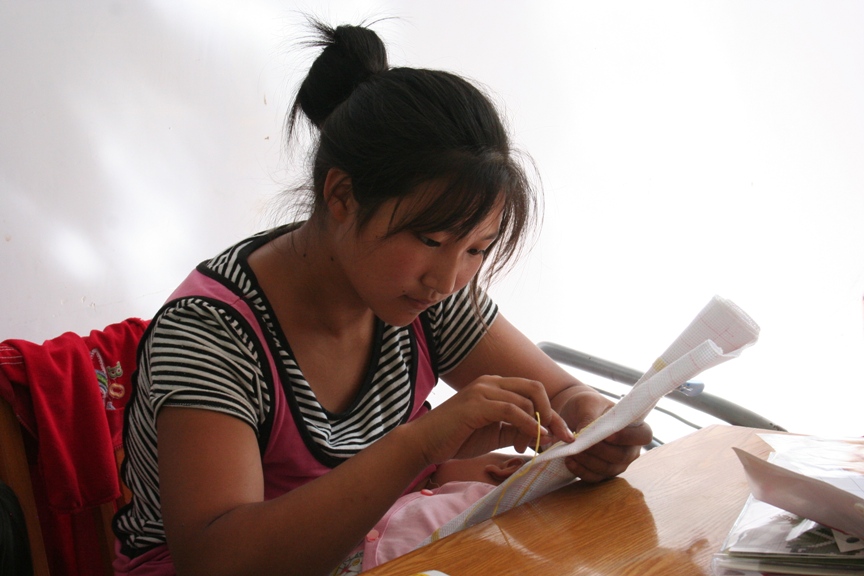
My first main task is to organize a woman cross-stitch learning group and also explore the chance of marketing on travel business in order to establish woman cooperation. Tactic goes from the combination of cultural industry and business, so that women can exalt their confidence on ability of craft and on economic independence and hence actively participate in the public business. The woman cross-stitch learning group is also the prelude of a woman school—women in village can initiatively gather to learn the related knowledge, concepts and practical skills, and to discuss the public affairs around their life. The progress as expected is still at very beginning, and meanwhile difficulties of complicated reaction flow under the silent village and the scattering of people which are the big challenge for me. The following tasks about the school course-improving and plan of lunch sustenance likewise face the similar challenge.

Scattered villagers and peasants’ sense of private interests

There are 11 pieces of natural villages at the administrative district, far from the top of deep mountains to the corner at the foot of mountains. The phenomenon of scattering and of peasants knowing their places by following the farming season is natural. Don’t know how the living style of those peasants here had been converted during the time of people’s commune in history of Mao’s period. Obviously not much remained, peasants limited by the locations and their own distributed lands after 30s’ economic reform only having their small concern on their own interests show reasonable results. However this custom may soon be defeated by the fast-changing structure of agricultural society in nowadays China. Brain drain and the influx of industry and business have gradually changed the way of village life. I’ve faced the difficulty of organizing women in the beginning, not only because of the scattered areas but also because women can’t see what the learning courses for if without talking interests or making money. It is a difficulty but also can become a means that attracts them to join the group by means of giving concrete benefits. However, this was useful for the beginning of organizing women into a group, but this might not be an efficient instrument for pushing ahead of learning process. From personal private interest to communal public good it needs transition. Without saying great so, even the request of learning from woman’s private room to the public space is hard to be achieved. Committed by double meanings of privately owned, village women even have to take more care of their own family thing and land under the labor structure change, without their men in village.


Training my language to speak out their interests
The basic aim for me and the Zigen coordinator of Qing Long Mr. Li is just to wish women or villagers or school teachers can actively gather within their groups and discuss or do some activities together. We believe that only the villagers get together, get powered through solidarity, and learn involving public affairs by democratic participation so the village can develop in progress. However this potential goal has to be packaged a layer and a layer by the language with the benefit or with chances to gain profit. As Mr. Li had reminded, we have to learn how to use their language to let them understand our purpose. What their language is much close to the reality and short-term benefit around their life.
Indeed, it’s not so easy. At least there are two barriers set in front of me. First, it’s not easy for me to understand their language both in phraseology and culturally. Villagers in north rural area of Qing Long speak Qing Long dialect though the language speaking is close to Mandarin. Some habits of cultural phrases are strange for me, but also fresh and interesting. I am interested in learning their cultural phrases but still hard to communicate while discussing things in deeper sense. The second is the most difficult one. I discovered that some things I said the villagers didn’t understand and some things I didn’t understand them are not just because of cultural habit but are about intellectual or non-intellectual. I somehow feel like there is a gap between me and them, and this is about the gap between peasants and intellectuals as Mao Ze Dong had emphasized. Since entering Zigen, I gradually realize how necessary that there must be an equal dialogue between the intellectuals and peasants, workers. Especially the intellectuals with more cultural capital have to go down to the village and to learn to know the peasants’ life. Many things about the villagers’ life along with the rhythm of farming are unfamiliar for me, though my grandparents are farmers too. The usages of cultural phases are deeply tied with the local life. Without getting along with their life for a long time, without involving their complicated relationship in village, it’s hard to understand their language and to say something concrete and real for them.
“How to speak out their interests by our own language” written in a book which is about how to activate the community recently become a theme going into my sense. Their interest is real, and our language combines our ideal and the understanding of others. The language use is quite delicate. It’s impossible to say their language but you can speak something that draws out their interests. I have tried to organize women into a group by means of searching, testing and drawing their interests in every stage. Meanwhile, reflect myself when some people don’t understand what I said. The process is still on. Don’t know how long it will keep, but just can head on by doing.

2011年9月26日 星期一

The September report-summary the progress of my project in KKF.

0 意見

This is the last report of this one year project,so I will do some summary about what happened in KKF now,and I also will report about the progress of my helping item of KKF ;and the last thing is Daycha will go to Taiwan from Oct. 9 to 19.

In March,KKF has a seed training of Thai NGO workers.The main purpose of this training is let NGO workers know about the knowledge of rice,because of these NGO workers who were work with farmers,and they need to know more about the knowledge of farmers is helping them to work with farmers,these three days training were taught them about the histoy of rice,how to keep the seed of vegetables,and what situation of farmers was suffered.

In the last day,the organization named Bio Thai which care about biodiversity,they made a speech and then held a discussion to discuss how to education farmers that they must to use their own seed,because of the big enterprise always cheat farmers that the seeds which they sell can let the corp have high yield,through experiment of plant seed bought from company and the local seed,the fact is that if farmers want have high yield of harvest compare with local seed,they must to use chemical fertilizer,or they can´t have it.And another important issue is take back the right of farmers,because of now the big enterprise also want to control seeds, and they develop hybrid seed constantly, because this is a big industry, and now more and more hybrid soy been and corn,they still try to develop hybrid seed of rice, but they still didn't success until now,that´s also the importance of keep local seed.The seed bank of government was all keep the seed which need chemical and chemical fertilizer, except this thing they do nothing,therefore Daycha invoke that bring the local seed back to the local place,and let the local farmers has their own seed.

On Sep. 15,there are two students of KKF ,they brought the rice which they plant by the local seed,because of KKF´s training,they went to seed bank and ask to take back their local seed last year,and in this year,they already got the harvest from local seed.

Another important things is about KKF now is preparing to sell the Bathmati rice to the export market,like middle east.The resource of seed came from three countries which are Canada, England, and India. KKF they started to plant Bathmati at seven years ago. Bathmati is the local variety of India,this variety just can be grew in Himalayan,and now KKF already plant it successfully.In these seven years,and they got more than 150 varieties,and in last July,they started to let farmers to plant them,and in July,they held a Bathmati testing activity to let consumer,rice mill factory and farmers meet each other,and then KKF will know which kind of Bathmati the rice mill factory will like it,and this is the direction they can make effort.The last step of KKF is they want to build the model let farmers,consumers,and KKF all get benefit from this model.This model is they sold the Bathmati rice to ricemill factory,because Thailand´s government ever tried to plant Bathmati,but they failed,and Bathmati has a good market that rice mill factory will export for KKF,even KKF just has few amount of it,so this is KKF´s advantage. KKF also can through supplying the Bathmati seed,nature compose,nature fertilizer,and nature spray for farmers to earn money,and then farmers they can get good price from planting Bathmati,this rare variety of rice.That´s KKF try to do in the next two years.

In april, when the CEO of Hao-Ran foundation Leo came to Thailand,we ever talked about maybe it was a good way to tell Kao Khawn foundation that I can help some part of jobs to save the problem that they in actually didn´t know how to use a volunteer. Finally,Leo communicated with Daycha that maybe I can help KKF to build the English website and helping about the Home Stay project.And after their meeting, Daycha also talked about these work with me. When the first group came from Taiwan finished their Home Stay of KKF, I asked the office manager to have a meeting to discuss what suggestions of Taiwan´s friend. Even the office manager, she said that their suggestions are useful, but I didn't  see anything get progress in Home Stay project, and the office manager ever invited me to join this project, but I didn't know what is next Home Stay group will come untill they are coming,so I can´t help anything of Home Stay project.

And regard to english website is also has no progress.Because of this job assigned for me,and the office manager didn't know about it until one day we chatted to each other.After one and half months she knew about it,and after that day, I ever asked her when should we have a meeting to discuss this job and then still has no progress.And even I just want to ask for having the key of office about 3 times,because I moved to second floor of office in July and I afraid that when I went outside if I didn't lock it,this will make some loss of KKF´s office,and the office manager didn't give me any answer except she said that she isn't sure where is the key shop.This kind of thing reflect that she does not want to say ”no” to me,even she really didn't want to give me the key of office,and even she can made some suggestion like,you can borrow the key of KKF´s staff,and she didn't say anything except the strange excuse.

You can said that KKF has their own problem of administrative ability, or you also can siad that if they can´t get any change except when they really want to change,or the really aware of this.

Daycha and another KKF´s staff who export in soil will visit Taiwan on Oct. 9.This time KKF was invited from Green Formosa Front Taiwan Association,and the ten days schedule was arranged by every part of Taiwan´s NGOs partners who care about the agriculture issue,so Daycha will make some speech about what KKF´s work and also visit some Taiwan´s farmers who work about sustainable agriculture.On Oct.19,they will finish their visiting in Taiwan.

2011年8月29日 星期一

I want to be a farmer, is it easy?!─The story of two young farmers

0 意見

I was responsible for a course called “Plant your own vegetable” in my ex-job. And this course was very popular and filled to capacity soon. Because the teacher of this course supply free land let student use it, and this also the reason why makes this course popular, this is a part that fulfill the desire of city people who want to have their own land to plant something.

City people want to back countryside
Now, more and more city people want to back to countryside to live their own life . In Taiwan, every year has more and more people joint the project that promoted by Council of agriculture which is educated city people about the knowledge of agriculture; A new book called “A journal of abandoning jobs” published in this February, the writer shares her experience about work in the countryside, and in half year this book already became most popular book in every chain book store. In Thailand, a TV program called “I want to be a farmer” which produce by a retired actress her name is Siriyakorn, this program also became very hot after it showed in April. And this program’s skill consultant –Khao Kwan Foundation received a lot of phone call that people said that they want to buy the land, and they said, ” I want to be a city farmer like Siriyakorn. ”

In these three months, I knew two young man who just became fresh farmer this two year, I am curious about their story.

The story of Chiang Rai ’ s woman ,Kwan
Kwan,she is 34 year-old,she has her own land in Chiang Rai, and now she work in Chiang Mai. I met her in May, because of I interview the Farmers’ Market in Chiang Mai, and she and her boyfriend was the youngest producer in that Farmers’ Market, they sold the organic To-Fu, and organic Coffee there. She quick form ISAC(Institute for Sustainable Agriculture Community, above called ISAC),and prepare to be a farmer.

Because of ISAC is an organization which promote organic agriculture, and Kwan was tired of talking farmer change their chemical farming to organic farming but the fact is Kwan even is not a farmer, and there is a little voice that talk to her that” I want to have my own farm now, I don’t want to have it when I retired.” Because her parents also are farmers, so she decided to do this decision.

I asked Kwan: why you decided to sell organic To-Fu in Farmers’ Market?” She told me that because of many consumers want to buy it, but no farmer sold it. In 2003 she ever went to ARI(Asia Rural Institute)in Japan learn about agriculture,and she learn about how to make To-Fu in that time, that is why she tried to sell To-Fu at beginning. They also sold sticky rice balls, because the rice can bought from ISAC, they just need to cook and made it; they sold coffee because of her mother plant coffee for a long time ,before her mother will sell to the middleman after harvest. and now she think that maybe she can learn how to sell it, so she start to learn how to roast, package ,and she also sent their coffee to examine ,and now they already passed examined ,so now their coffee are organic. When the day I met he, she told me that she already change a new roast factory, because of their quality is more stable, so she accept the higher price to pay it.

Kwan and her mother are pick up coffee fruit


About the future, Kwan mention that she are considering that whether she stay in Chiang Mai or she go back to Chiang Rai, live with her paren. If she stay in Chiang Mai, her way will focus on progress products of agriculture, and if she go back to Chiang Rai, their house located in National Park, there is a lot of natural resource, so she has another way to complete her dream. She told me that compared with their neighborhood effective arrangement, the amount of their 600 coffee trees were very few, so she plant 400 coffee tree in August ,and the selling was made by herself. After tree year until these coffee tree grow up, there comes out coffee fruit, and then they can have coffee bean. So far she still needs to do freelancer, having some case to balance her expenses. Because of now she can’t survival by being a farmer.

These are Kwan hand made TO-FU

The story of Bangkok man,Nakorn
Another young man who live in Bangkok, he is an example that he is a urban farmer.
He is 28year-old, and he changed his career to become a part-time farmer two years ago. Because of his master major in agriculture, and his first job was researched about agriculture in community, too. Therefore he has more experience than general city people. After he finished his first job, he wanted to a farmer and he didn’t separate with his family, although he lives in Bangkok, that’s why he built a city garden in a house, and he became a city farmer.

Nakorn, he wants to be a farmer still under some pressure from his family that his parents afraid that he is unable to supply their couple own expenses,as the third generation of Thai-Chinese. Nakorn, in the beginning he joined the Green Market .He sold some selling of vegetable, and also taught people how to make kitchen waste become compos, and then he started to plant his own vegetable and learn to sell them. And now there are two customers became his client. His client will receive a week twice vegetable ,a week 3-5 kilogram, and the variety of vegetable he supply is depend on what he plant in that season, in another way, Nakorn also planes to establish a City Farmers network in the future. He hope this network can let farmer who join this organization can support each other, and this network will hold some courses, let fresh farmer have chance to learn about agriculture, he also hope through this network can bring up customers who has customer’ conscious, and let producers and customers have good interactive.

This is Nakorn's city farm-1


This is Nakorn's city farm-2

Nakorn do selling by himself

When Nakorn 26 years old,he decided to be a urban farmer


I ask Nakorn,”How many people want to be an urban farmer?” He replay me “a lot of people want to follow up.” Now, he is trying to find the model that how big garden can supply how much consumers. He also talking about that he hope he operate his farms in a social enterprise’s way, for example, he can teach the community which need some help, how to make kitchen waste become compos, or teach them how to plant the selling and then they can sell to the urban farmers, city people, and this is a good model of social enterprise.

New generation farmers are easier to choose a sustainable agriculture road
From the above, we will found that, now new generation farmers, maybe the way they will be is they are part-time farmers; in the part of skill, it’s a basic equipment of a farmer, you need to fill a vacancy by yourself, whatever you can get it from any kinds of tract to add your own knowledge about agriculture ,marketing, and the best is you need a support network which can support you when you have a question or any problem; and the most important part is choosing a sustainable agriculture road. After all, new generation farmers has information advantage than before, they are very clear about that the old farming use chemicals are bad to the rice field, and the advantage for environment of sustainable agriculture.

Now, they are plant their crop in sustainable way, even now their income and expenditure still can’t balance, I believe that they’ll find their way, and they will make their dream come true in the future.

2011年8月25日 星期四

“Democratic education” and the community empowerment through Zigen’s work in China, can it be real? (Part3)

0 意見


By Huei-Jen Lin

The idea of democratic education and the reality of what Zigen’s work on community-empowered

The community/social work in China in essence is more or less like “social service” which goes along the governmental/party system, and this idea also just has been imported from the west in the last two decades. In reality, wherever in cities like committee for community service (居委會), the service for the migrants (流動人口服務站), or in rural areas like committee for village service(村委會), women union (婦聯), as an autonomous organization, their services actually are much closed to the “conduct” way — from the top to down, they follow the superior’s mandate which usually requests information about demographics, governmental propaganda, and implementation of central or local governmental policies. Several local NGOs like Zigen or others go another way round: rather focus on the disadvantaged groups or communities by means of relief given, resource service, community-empowered or protest for the right. (維權)

According to the different style of project coordinators, different areas (political power structure, cultural habits…) and the problem groups they face, those projects that Zigen design have been operated in various way. However, from my observation, “community-empowered” are the main core that Zigen is trying to adjust the strategies of their organization themselves to be, and trying to have practice. From the method of relief, resource given in early time to nowadays that they think that village/community-empowered could be much closer to the aim of Zigen: human centered; development of sustainability.

From aspect of community-empowered, different situations have been displayed on Zigen’s migrant workers’ community center of Beijing, and on the projects of village-school building in the rural areas. However, to contribute to the ideal of community-empowered, education is the common means which Zigen often use and with the Chinese educators’ thought supported. [1] They believe that all disadvantages in communities who can be empowered must be channeled through the education.

In the migrant workers’ community center of Beijing, the director Mrs. Yu is trying to establish a platform that promotes the better understanding and the healthier dialogue between the migrants and their surrounding society. The Zigen workers have designed several learning programs which connect thecollege students/social volunteers with the targeted groups: migrant workers, migrant children, and ant tribe [2].

1. After school program: (1) A college league who had cooperated with Zigen to teach review classes for the migrant children (about third, fourth grade) in the center on the weekend. (2) One-to-one learning: some students of this league regularly go to some students’ home for classes reviewing, and interview. (3) Zigen workers teach a class in migrant school to give advises for 5 and 6 graders who are nearly to enter the society.


2. Activity program: the center has been built as a learning environment which is set books, films, and chess. Those related activities, information of law and health are usually taught by Zigen workers or the college league in every evening for the migrant workers.

3. Study meeting program: the Zigen workers organize a meeting to read and discuss together and open for the people around the community, mostly are the ant tribe. Most of time, they were studying the thought of Mao Zedong, about his essays on education and philosophies. In discussions, a kind of socialist values and lifestyles is attempted to deliver out: any group who becomes disadvantaged is not destined to be, but is oppressed by the unequal social structure (the capital class) and relatively lacks the social capitals. Any worker is not destined to be only a worker, but is a human. Therefore the migrants shouldn’t always be depicted as victims. They should understand what problem they situate and why it is, and therefore they can fight for their right and know how to live in this society.

In total, Zigen here try to create a space that let the society realizes the migrants and respects to them. Meanwhile, the migrants should be empowered by their participation within this platform and get to know themselves even as the disadvantaged group are deserved to be respected and to be given the right as the normal habitats. The performance and the idea of this platform are similar to some organizations’ work based the idea of democratic education: eve

ryone should be equal; has the rights to learn, to teach, and to participate in the public affairs and the decision making. However, what I feel the difference is that, in this case the so-called “equal” is rather addressed to the class struggle—the right for the disadvantaged group should be equal to the normal people. That means, this disadvantaged group is perceived as a group, so the idea of the right or freedom something is for the group not individual. Probably it’s because that the Zigen inherits the Mao’s thought and migrants here are more implicated to the working class (most of migrants are workers). The other reason may be the Chinese cultural habits—collectivism, so when talking people’s right, the benefit of a group will be at premise.

In villages, Zigen is trying to promote a big project called village-school building together. They try to give the support for the basic need on both sides( village and school), and then above this base they try to build a community where the villagers can care and participate in the school affairs and the resource of education can be used broadly on the villagers. Zigen workers in village have tried to organize some groups for some disadvantaged people like women and the elders, but also for the peasants their economic need. The idea behind this action is to empower people for participating in the groups’ things by means of the people organized as several groups. Then the villagers can really discuss the public affairs of village and have the right to participate in the governance and make decision. For the education part, the village should a big school that a learning environment can offer villagers at different ages to learn when they need. This is the high level ideal of this project. Till now it’s been moved on slowly: some villages stay at very basic level, but a few are going to step into have the organization for adult education.

Again, it shows the culture of collectivism. The Zigen workers perceive women, the elders and the left children are disadvantaged groups. They try to organize them as the women association, the association for the elders…, and then through holding activities or training to empower them. The villagers are not perceived as individuals, so they can organize the groups in terms of their personal hobby. Another reality in village is that the villagers couldn’t really feel free to participate in the public affairs, due to the existing power structure of village, relating to the authority of communist party members.

“Democratic education” and the community empowerment through Zigen’s work in China, can it be real? (Part2)

0 意見


By Huei-Jen Lin

Several ways leading to democratic education: Four types of participants on 2011 IDEC

All those schools/organizations who had participated in IDEC could be classified by their fields and functions into four types:

1. Democratic education schools:

Mostly the range of the ages covers the stage of kindergarten (3-8y) or till the stage of elementary school (3-12y), or the ages of 12-18 years old. The forms of the schools are also displayed variously: boarding schools (free and alternative), home learning schools (parent education or community education) and the mixed with state systemic schools. School and student council for the equal discussion and decision-making are the crucial component of democratic school. One school in US showed the case that students can participate within the decision making of hiring and firing teachers. Meanwhile, another school in Peruvian Andes (Escuela-democratica) presented their fighting for child protection and for the independence of learning but is being struggling with Peruvian military government.

2. NGO/NPOs:

  1. Policy advocacy: protect the children right, advocacy for the educational events and the law/regulation revise. Ex. EUDEC (Europe), CWC (the Concerned for Working Children, India), Building Bridges Project (Germany)…etc.
  2. Actionists for alternative/progressive education: APPAE (Australasian Association for Progressive and Alternative Education, Australia), BFAS (National Association of Free Alternative Schools, Germany), DISKO Demokrati i skolan (Democracy in school, Finland), ESSA(English Secondary Students’ Association)..etc. Alternative education is that which promotes the use of democratic decision making process in the school/learning center. And the progressive education is that which emphasizes personal relationships between learners and teachers, with including an awareness of and a breaking down of power dynamics.
  3. Community education or the rural development program: NGOs like Aprendiz (Brazil) …etc. try to create the community-powered learning environments to improve the poor condition of learning and to empower the learners in the rural areas or in the slum areas in cities .

3. Conference & Network: AERO (USA), IDEC, APPAE (Australia), EUDEC…etc. Most of them aim at bringing forth a diverse collection of national and international voices to address and exchange what transforming education & our world means to them.

4. Education reform/movement in the state /public school: sources are from the personal normal teachers, parents, students, scholars or the support of governments who are trying to deliver the input of democratic elements into formal educational system.


Pic3: A educate worker teaches math with beans in Peru.

Pic1: A community worker from Pic2: A teacher who graduated

Aprendiz (Brazil) the dilemma of from Sands school (democratic

community work in slum area. education) now is teaching in

a free school in Leipzig, Germany.


The running performance of 2011 IDEC and democratic culture in parliament

Since 1993, IDEC in respecting to its spirit of rotation had been held by different schools/organizations in different countries: Israel, Palestine, UK, Austria, Ukraine, Japan, USA, New Zealand, Germany, Brazil, India, South Korea..etc. 2011, again in Sands school of UK, IDEC was almost organized by sands school students (13y-17y). It had been running for ten days; two days were scheduled conference and the others were for the open sessions and parliament. This fully displayed the base of democracy that let many different groups had chance to present their work and idea for the exchange or the discussion. Moreover, on aspect of living in IDEC, though it was mainly arranged by Sands school students, a space was still opened for the participants to join the management of living business and evening activities. This conference was rather unusual than the other academic conference which I had attended.

In parliament, any issue about the ideas, the running process, regulation or the structure of IDEC could be posed and discussed by all participants, but be decided by the members who had held the IDEC. For me, there were two interesting issues been posed and been discussed profoundly. One was about the worries that IDEC may be replaced with the EUDEC while EUDEC with owing the most participants of IDEC is becoming a stronger and stronger organization. Already, it has uneven power structure inside of IDEC, such an international network. The most members of IDEC are from Western Europe and somehow the idea of democratic education came from its thought. Interestingly, during the discussion, from that people considered the frequency of IDEC should be adjusted to every two year in order to avoid the crash with EUDEC activity (EUDEC centered attitude behind), turning to insist the normal frequency of IDEC and its structure with no organization based for. (Be aware the pre-inequality existed in multiculture and be more concerning the equality of internationalism) Decision was not changed, but the people’s existing concepts might have been overthrown through the discussion. The other issue was about whether Taiwan with undergoing the essential democratic education development under the special historical background of the social/political movement of democratization can hold the IDEC in 2013. It was a fierce discussion in parliament, because there were about 3 countries whose organizations were competing for. Arguments in most of time were addressed to the principle of rotation: remarkable discussion that whether to obey the rule or to have an exception or criticize the rule. Unfortunately the decision didn’t stand with Taiwanese side—decide to obey the rotation finally, but some suggestions had been given. Through the come-and-go arguments, the questions had been deepen and been considered broadly. It was not just about the level of advantages or the shortcoming of rotation, but implicated to the level of the wrestle and balance of power relations among different countries

From my observation, in parliament, the democracy here was not that kind of political game, though there were still some unavoidable power relations in between. It basically respects everyone as equal and every opinion deserves to be voiced out and be respected, including the adults and the children. (about two children in parliament)

On several days of open sessions, many interesting and profound discussion were going on: “Democratic education in undemocratic society?!”, “How to implement the elements of democratic education into the state school system?”, “Democratic education fighting for individual right in the collectivism society?!”, “Can democratic education be universalized?”, “the idea and its practice of education city”, “How to run a school without the rule?”, “How does democratic education act for the disadvantaged group?”……etc. Each topic was posed and presented by each group who had confusions or answers in terms of their practices. Topics might be looked idealistic but people here at practical level had tried to make them be real. During the discussion, in fact the more was the unsatisfied questions than the satisfied things what many groups had done.


2011年7月25日 星期一

July Report- “Democratic education” and the community empowerment through Zigen’s work in China, can it be real?

0 意見

By Huei-Jen Lin

Introduction

IDEC (International Democratic Education Conference) 2011 in UK had just finished in the middle of July. It contained around 300-400 representatives of schools and organizations from 29 countries which are doing things related to the theme of democratic education. “Education based on respect for human rights”: Protecting the right for children”, “right to decision making”, “right to learn”, and “right to be equal”; “Pluralistic education” and “dialogic relationship” ,all are the key words for the principles of democratic education that often shown on the discussion of the conference. Driven by the different types of schools and organizations according to the different political and societal circumstances, democratic education has been practiced into various areas: alternative schools, normal state schools, communities where locate at the suburb or poor rural areas and the governmental regulation of schooling. Those practices have created a different kind of learning environment which is apart from the normal educational system—a pyramidal structure, a kind of elite education. Quote from the speech of Israeli educator and also a pioneer of democratic education, Yaacov Hecht; the main aim of democratic education movement is to break down the pyramidal structure, to release the educational resources and professional authorities from the top. Then the educational system should be looked like a net, which means any person with any profession could be a teacher, and also be a learner through the rather equal learning network.

Pic1: About 29 countries participate in


Pic2: Open session


Pic3: Parliament


This idea in a certain way quite fits to what Zigen is trying to do, creating a kind of learning environment in the rural areas and migrant groups at the suburb areas. The main purpose behind this action is to empower the disadvantaged groups including the children, women, the elders and the migrant workers. Raise people at the lower class to have a sense of the right to learn and the confidence to participate the public affairs. However they just started at the very beginning, and have to be very careful of the governments’ attitudes. The essential of democratic education or in their words: everyone can learn and everyone can teach, hasn’t become a real existence within their actions. Besides, I quite doubt that whether their action road will lead to the essentiality of democratic education because of their cultural habits of collectivism and the belief to authority of communism. They may rather more focus on the class problem, in opposition to the capitalism.

On the other hand, for the long-term relationship with IDEC, the “Holistic school” in Taiwan where I had worked for had been involved within the thought of democratic education and been initiated under the background of democratic movement of Taiwan in 1990s. Though the school’s starting idea of subversion to the authority of education system was more welcomed by the middle class, its 16 years’ practices in fact deepened the understanding of power relations between teachers and students, adults and children, and among the people in the different social classes.
As attended this conference, my experiences from the both sides therefore deserved to be communicated with those schools/organizations from the other countries.
(To be continued)

2011 July Report─The Simple Life in Pathom Asoke

0 意見

Khao Kwan Foundation (KKF) is located in countryside. However 20 years passed by, the farmers live near KKF still use chemicals in their rice field. KKF’s founder Daycha, he ever visited the owner of the land which near KKF’s rice field ,the farmer uses chemicals and fertilizer. He chat with this farmer, the farmer told him that now his health is bad, and the harvest of rice is bad, so he was in debt, and he even said to Daycha that : ”Soon or latter this land will belong to you”. Daycha asked him: ”Why don’t you learn from me, like me, I do nothing on the rice field? ”He said, ” It is except that you change my religion! ” Because using chemicals is his belief.

Otherwise, if someone think that we don’t want to kill any life, and practicing organic/ natural agriculture is the only road. Asoke community has long history in Thailand. And they are famous by promoting vegetarian. In July 12-18, I went to Pathom Asoke community and live in a week to understanding their lifestyle.

According the Chinese reference I got that point there has 7 Asoke Community now, but because of every year maybe has increasing, so this might not the correct number. This community was created because of leader called Phra Bhodhirak. He was born in 1934,and he was a famous TV host、composer ,he quit his job at 35 year-old, and few months later he became a monk, he shocked his relative and friends. And then he created the Santi Asoke clergy group. He insisted on vegetarian, because of the first precept of monk is refraining from destroying any life. It is contradiction that monks said that people can’t destroy any life, but they accept people give them the meat. Therefore, Asoke group promote vegetarian strongly , they produce material by themselves, there are some vegetarian shop in Bangkok and Chiang Mei.

Phra Bhodhirak obeyed the precept strictly, and his behavior is different from the mainstream Buddhist clergy group, and then he was accused to the religious court.
Because he committed to reveal the essence of Buddhism, so this 10 years long lawsuit doesn’t hurt his influence. He ever said that: ”Yes, I have a sharp tongue. But it is only because there are already plenty of monks using the carrot. So it is my job to use the stick.” Phra Bhodhirak encouraged people working hard ,and practice with open eyes, engaging energetically in any type of work instead of meditate by sitting or walking. In Asoke community, they are anti-consumerism, because they refuse to follow the whims of fashion.

The leader of Asoke,his name is Phra Bhodhirak


The land of Pathom Asoke, it comes from someone’s donated. People who live in this community need to obey rules. that is to “keep the five precepts.” This five precepts are below: 1.Don’t kill any life,2. Don’t be a thief, 3.Don’t betray your lover
4. Don’t tell a lie, 5.Don’t drink wine or anything which can let you addicted to it.
They eat two meals a day, one meal at 9:00 O’clock, another is at 16:00. At beginning, I am not used it, before the meal time I ate some fruit to stop hungry, finally I found that when this become a habit and your body will used it, someone even just eat one meal a day.

Because of the Asoke community doesn’t use money, like eating, living, trafficking, education is free, therefor everyone here worked hard, no matter how old you are, young age like 13 year-old, or 84 year-old. They wake up 4:00 o’clock, and everyone working in shampoo’s factory, kitchen, organic garden, community shop, snack bar, tofu’s factory, mushroom’s garden, school, their own media-FMTV, etc. When I saw the monk, he operate the complicated machine by himself to broadcast, and the high school’s student operate camera to shoot the big campaign, senior high school’s student drive a big trunk…,it is all surprise me ,and I found their attitude, no matter who you are ,you need to learn any work you do. And, everyone has not only one job, like a teacher, he teach student as volunteer, and except his teach time, he need to work in factory, or being a driver of cars ,etc. Let me feel the Asoke resident like the worker bees in the bee society, everyone everyday wake up, and working all day.

One of the Asoke resident works in community's shop

The student,the teacher,and student's father,they all work together to prepare food for
community's resident


The teacher were teaching music to students

Every time I throw garbage in Thailand, I always wonder that: “Why the Thai didn’t do recycle on garbage? ” I came to Thailand over 8 months, this is the second time that I saw the place has recycling garbage can, and the first time I found that is in the hospital. This community has a recycling center, somebody is responsible for separating garbage and sold the worth resources. , And they have a second-hand shop, this shop selling the materials which were sent from the neighborhood, and they are responsible for cleaning or fixing it. Because of Asoke community emphasize on giving, their goal is not get profit, the price of second-hand product is low. Otherwise, all girls or women are have short hair, and they wear the uniform, it is a blue shirt, because they refuse to follow the whims of fashion.

The recycle garbage cans,there show pictures to point out which recycle item to put in,even
foreigner,like me can understand it


No matter who you are,everyone here wear wiht the blue shirt

I am impressed about in Asoke’s education. They established boarding-school for high and senior high school student in 1992. The Asoke’s school is called Samma Sikkha school, there is no tuition or other expenses; teachers work for free. Their daily schedule like below: wake up at 4:00-4:30, start to study , in the morning they always do something related to study; in the afternoon they start to work in the community, for example: cooking、plant vegetables、package the shampoo、pick up the mushroom…etc. After 6:00 pm they continue to study until they go to sleep in 9:00 pm. There are 66 students now, in the beginning, I thought almost students come from community resident, until I met a father who comes from south of Thailand, I chat with he, he said to me that he came to see his daughter for one weeks. And the teacher also told me that now only 3 students come from community resident, because a lot of resident here are single or they are only couples, they didn’t have a child, so almost the students are come from other part of Thailand.

Before student's breakfast,the monks will lead students pray,and then having a speech to them

In every working place, the workers are the teacher of students, teach them how to operate the machines, and how to good at work, it is also let student learn how to teamwork. The work item will change every 7 months, so every student can do every kinds of work in this community. I am very appreciate their thinking of education, I think learning is not only on textbook, but also let a person have a living skill, in this way a man can live alone in everywhere. Because I speak Mandarin, so I knew a Thai girl who can speak Mandarin. Her Chinese name is Lee Yu Hong, and she was a student in this Samma Sikkha. She told me that this school emphasis is on developing and strengthening the students’ character, training them to be good people, work hard and be unselfish, and the last thing is reading. The students need to obey the precepts strictly, if they break the rules, there has small punishment, but if the situation is more serious, the school has its own stay down system, and the student will stay one more year.

Originally, I plane to go Pathom Asoke on 7/4, because of they are busy on parade. Is it real that a Buddhist group on parade? It’s let me feel curious and I ask about this activities. This campaign goal is to teach a lesson to politicians who are planning to enter the parliamentary system dishonorably by buying votes. They also want to push for political reforms by using the blank ballots as a reminder for politicians to heed the voice of the people.

Before 7.3 election of prime minister, the yellow-shirt group organized a team to hold a seminar to promote the group's ''Vote No'' campaign for the upcoming election. And before 7.3 election, Pathom Asoke and yellow-shirt group has a “Vote No” parade together, and because of this campaign, almost two millions people do invalid votes. The same as Phra Bhodhirak, the leader of Asoke, his criticism attitude towards to the mainstream Buddhist group, Asoke resident told people that there was another choice, if you were already tired of policy in Thailand.

I lived here for six days, and living with the simple good: I ate two vegetarian meals, sleeping on hospital bed, and using bicycle; (In fact, the resident here, they are barefoot, because this way can let people focus on walking. ) All environment I saw was forest、river、simple buildings; and everyone I met here, they not only welcome me to come this community, but also they said : ”Wish you everything is well.” Although this is the first time I come here, I feel very peaceful. I think that is because of the people, things and whatever I saw, everything is positive and pure. Like the sentence which was written in an introduced book of Asoke, ”While the materialist is mainly interested in goods, the Buddhist is mainly interested in liberation.”


The German Economist Ernst Schumcher, he ever mentioned in his article called “Buddhist Economics”: “As physical resources are everywhere limited, people satisfying their needs by means of a modest use of resources are obviously less likely to be at each other’s throats than people depending upon a high rate of use. Equally, people who live in highly self-sufficient local communities are less likely to get involved in large-scale violence than people whose existence depends on world-wide systems of trade.”

The environment in Asoke community is beautiful and quite


These are houses of monks and nuns.It's so simple.Because Asoke's goal is to put spiritualwealth in people ahead of worldly things

Now, The food self-sufficiency of Taiwan just have less than 50%, we are the people who “people whose existence depends on world-wide systems of trade.” Do we will get involved in large-scale violence? The oil price is expected to soar to an unimaginable extent along with the development of emerging economies, such as China and India. At that time, it is hard to say that Taiwan will having “food crisis” or not, because of Taiwan is the country which highly depends on import foods. I think that small is beautiful, a self-sufficient community, such as Asoke Community, it is a good example for Taiwan to reference.

This is Asoke organic fields,it's also a place to let srudent learning how to plant


Reference :
1. Marja-Leena Heikkila-Horn、Rassamee Krisanamis, ”Insight Into Santi Asoke”. Fah-aphai Co.Ltd

2. Tai-ASEAN Network News,“People's Alliance Continues Campaigning for "Vote No"” . 2011-04-11

3. The Nation, ”PAD makes final plea in 'Vote No' campaign”. 2011-07-02

4. The Nation, ” Figures show PAD failed to win support for 'no-vote'”. July 5, 2011

/

總網頁瀏覽量


游擊女孩看世界. Copyright 2010 All Rights Reserved. Maintained by Tzuche Huang